European Furniture Styles
Medieval Styles
The Gothic style Furniture started with solid, simple pieces, and evolved towards a more refined, elaborate execution. The Gothic style reached its finest in the Flamboyant age, when exquisite works of art of an architectural appearance were created. The fine carving, with typical motifs like Gothic arcades, the tracery, the linen-fold, or depicting human and animal figures, is giving the Gothic furniture its distinct, unique character.
Renaissance Styles
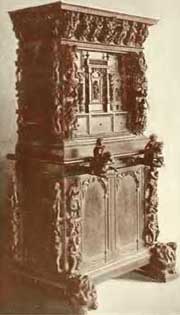
The European furniture styles of the Renaissance period were all influenced by the works of the Italian craftsmen. The Italian furniture styles were imported with no modifications until the local artists, after learning from their Italian counterparts, established their own distinctive styles. In France, the furniture style under Francis I was predominantly Italian. With the reign of Henry II, the French craftsmen began to modify the principles they borrowed from Italy. Artists like du Cerceau and Sambin applied their own ideas and their own interpretation of the classical antiquity, developing original schools which defined the Henry II furniture.In England, in a similar manner, two styles were developed during this period, the Tudor style , and the very distinct Elizabethan style.
European Styles in the 17th Century
In England, the Stuart style is covering almost the entire 17th century, with the Jacobean proper covering the reign of James I and that of Charles I. While the Jacobean was still influenced by the Elizabethan, Inigo Jones contributions, and continental, mainly Dutch, influence will gradually led to the emergence of new furniture styles.
The French style of the early 17th century is still Renaissance, including the Louis XIIIperiod. The long reign of the Sun King witnessed the development of the majestic and grandiose Louis XIV style. It was the age when the famous "Manufacture des Gobelins" was established, and when André Charles Boulle created his luxurious furniture.
18th Century Furniture Styles
In 1689 William of Orange became King of England. It was the beginning of the Anglo-Dutch age, which can be divided into three periods of furniture styles: William and Mary, Queen Anne (1702-1714), and early Georgian under the reign of George I (1714-1727).In France, the long reign of Louis XIV ended in 1714. The transition period represented by the Regency (Régence) was followed by the explosion of Rococo and Louis XV styles.